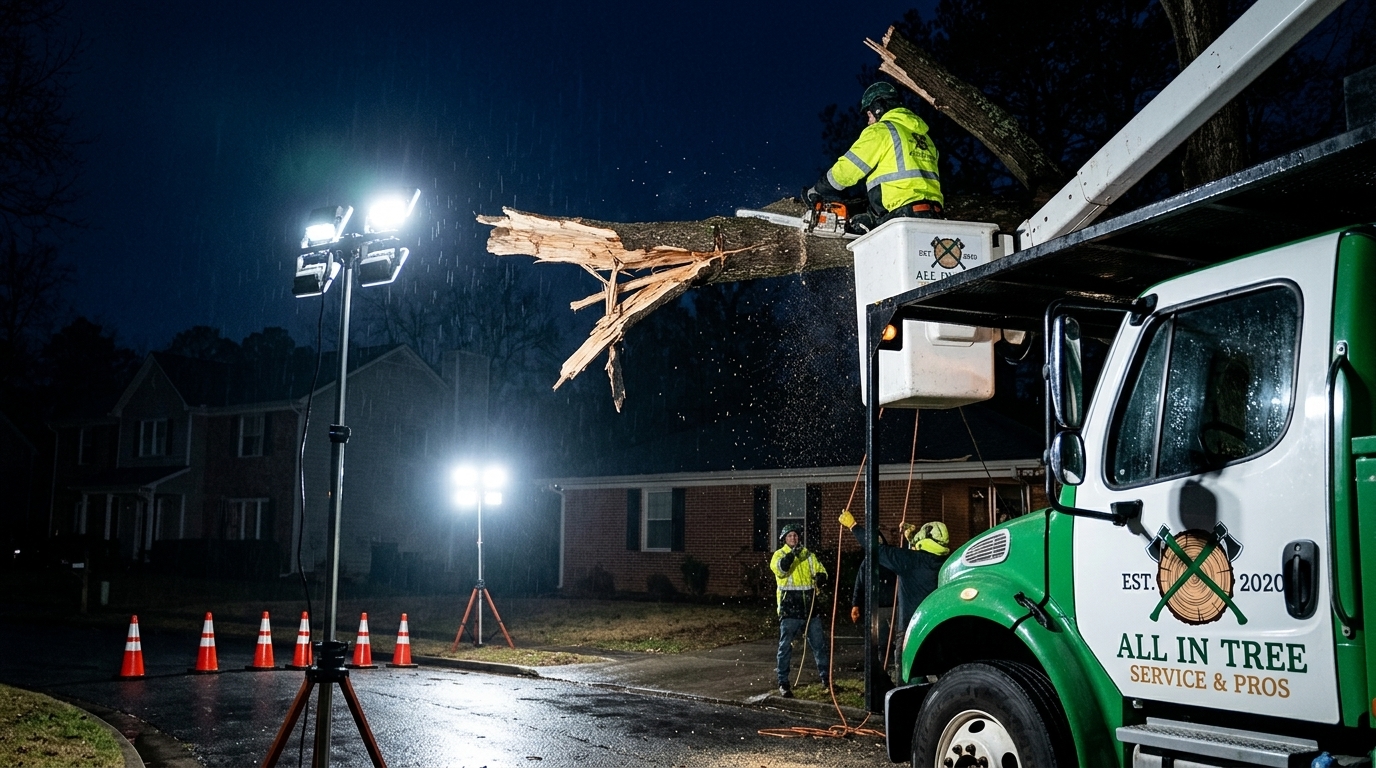
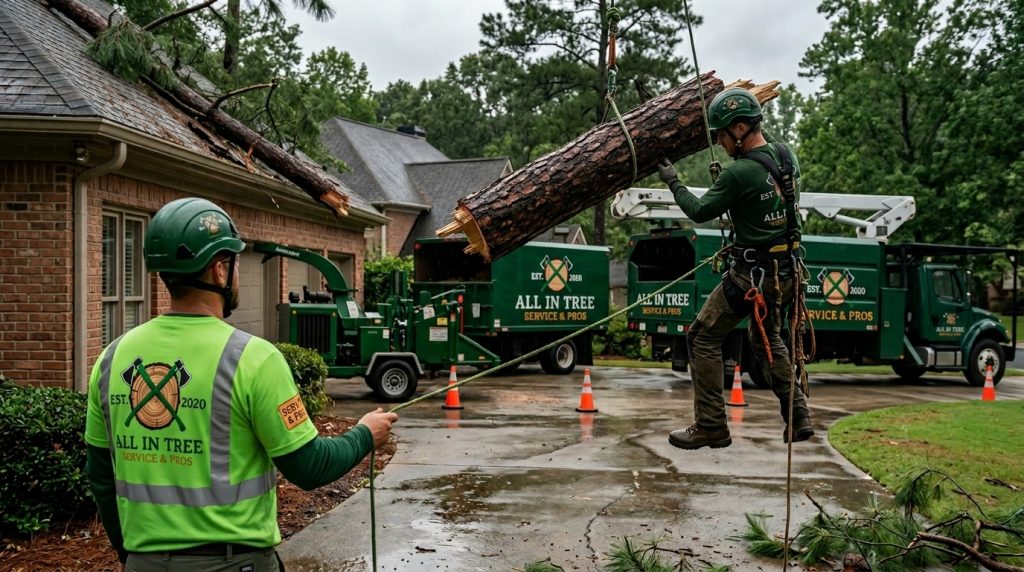
If you have a tree emergency right now, call (470) 608-2545. We respond 24/7 across Metro Atlanta and North Georgia.
Average Emergency Tree Removal Costs in Georgia
Emergency tree removal in Georgia typically costs $1,000 to $8,000 or more, depending on the scenario. That range is wide because emergency jobs vary from a cracked limb hanging over a bedroom to an 80-foot oak sitting on a roof.
Here is what we typically see across our service area, broken down by the most common emergency scenarios.
Emergency Scenario | Typical Cost Range |
|---|---|
Large limb or branch on a structure | $500 to $1,500 |
Small to medium tree across driveway or road | $800 to $2,000 |
Medium tree on a fence, shed, or detached garage | $1,200 to $3,000 |
Large tree leaning against a house (hasn’t fallen yet) | $1,500 to $4,000 |
Large tree on a roof or structure | $2,500 to $6,000 |
Large tree on a house requiring crane removal | $4,000 to $8,000+ |
Tree on or near power lines (utility coordination) | $2,000 to $5,000+ |
These ranges reflect what Georgia homeowners actually pay in 2026 across Powder Springs, Smyrna, Mableton, Fayetteville, and the rest of Metro Atlanta. Every job is different, and the final number depends on the factors we cover below.
Why Emergency Tree Removal Costs More Than Planned Removal
A tree that needs to come down on your schedule costs less than a tree that needs to come down right now. That price difference exists for specific reasons, and none of them are about charging people more because they are in a bad situation.
After-Hours and Weekend Labor
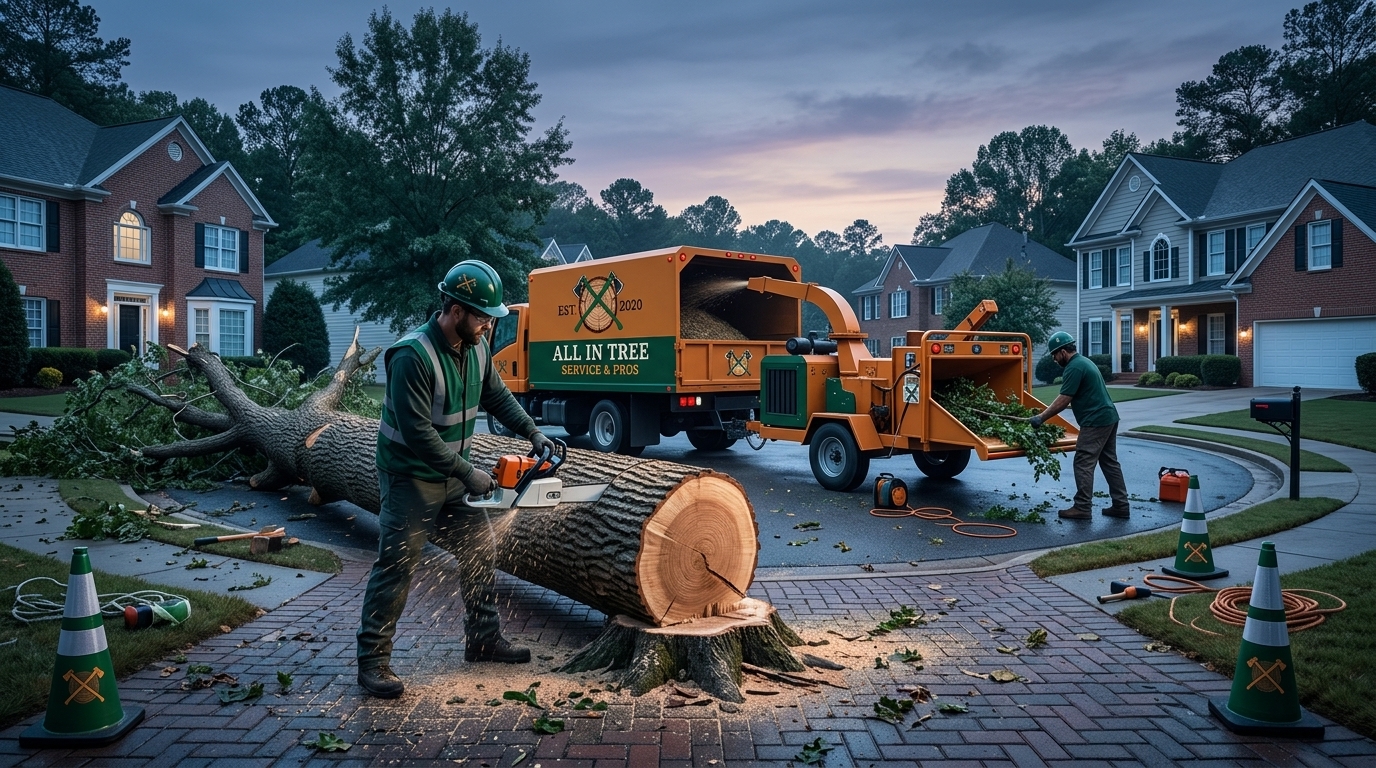
Emergency calls come at 2 AM on a Sunday. They come on holidays. They come in the middle of dinner. Our crew drops what they are doing and mobilizes. After-hours labor costs more because we are pulling people away from their off time, loading equipment in the dark, and working in conditions that would normally wait until daylight. That premium runs 25% to 50% above standard daytime rates, and it is consistent across the industry in Metro Atlanta.
Hazard Premium
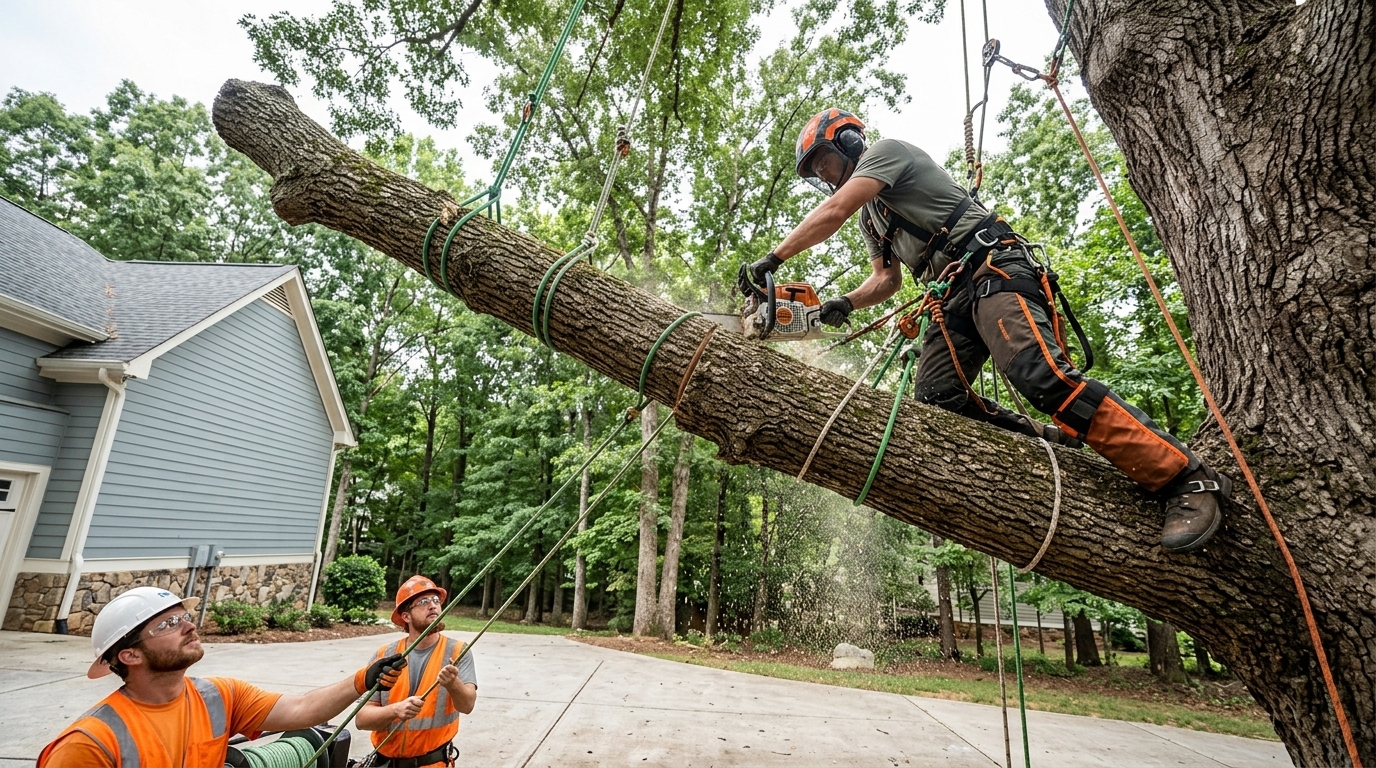
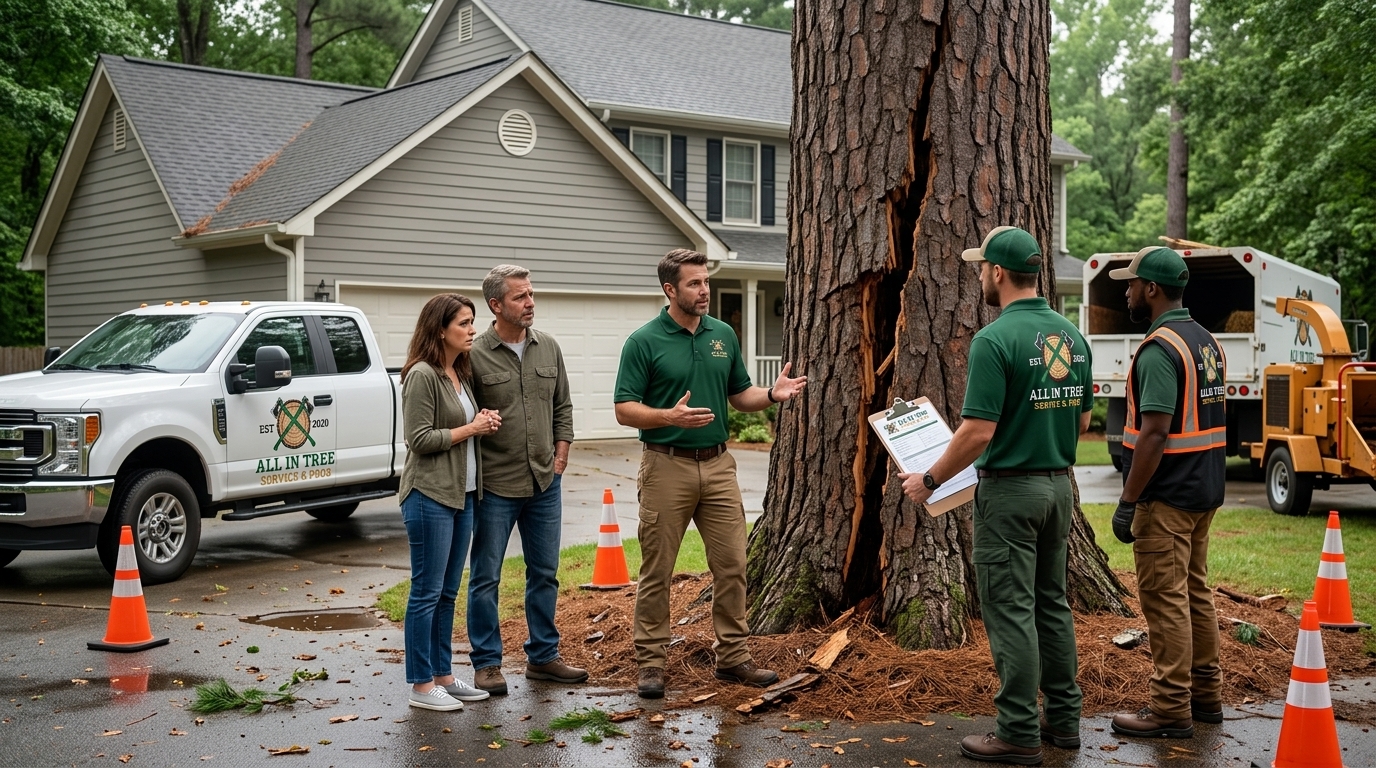
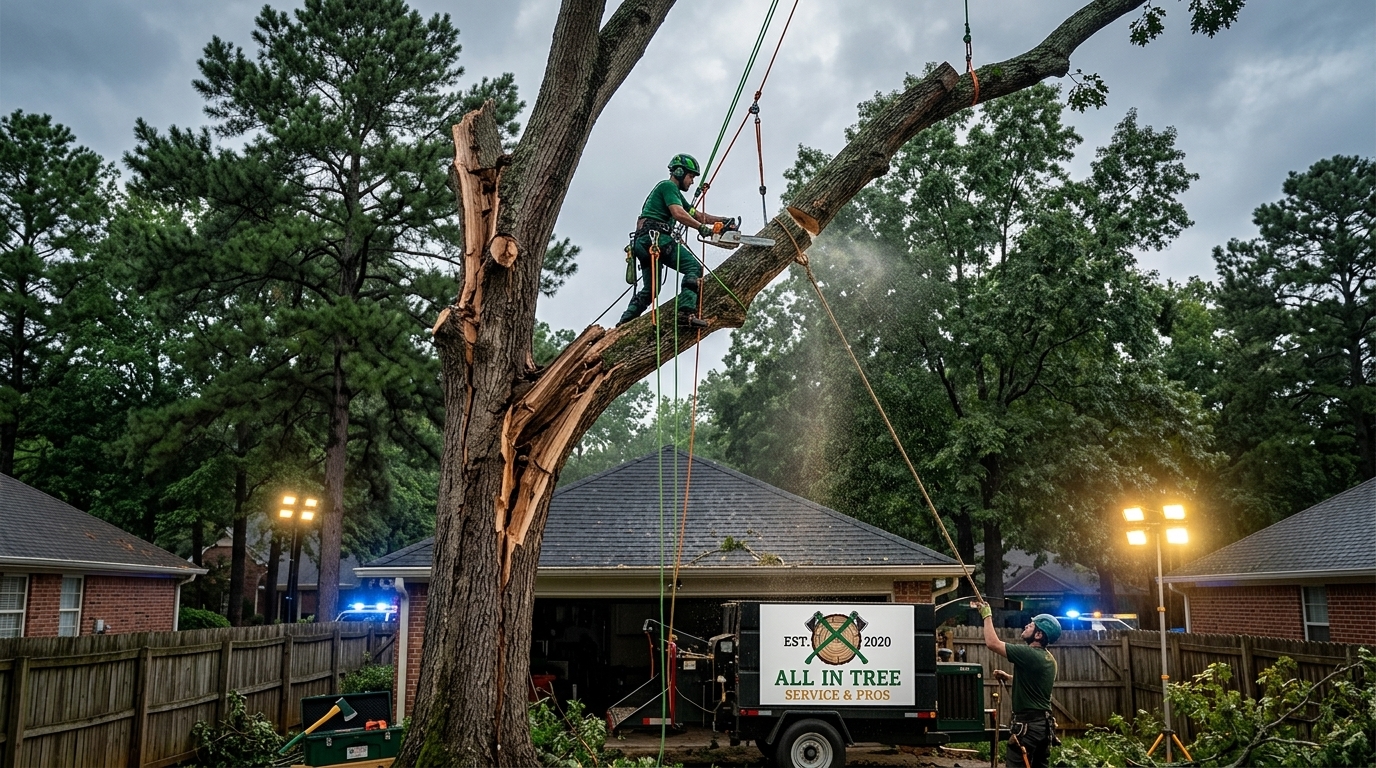
Emergency trees are unpredictable. A tree that just cracked at the base and is leaning against your house is under stress. The wood is under tension and compression in places that are hard to predict until the climber is up close. A storm-damaged pine with a split trunk can shift at any moment. Our crew takes more safety precautions, uses more rigging, and makes smaller cuts. Slower, more careful work costs more.
Equipment Rush and Mobilization
Planned removals are scheduled days or weeks ahead. The crew loads the right equipment the night before and drives a direct route in the morning. Emergency calls mean loading everything we might need, driving to the site immediately, and sometimes bringing backup equipment in case the first plan does not work. If the job requires a crane on short notice, the crane company charges a rush fee on top of their standard rate.
Higher Insurance and Liability Exposure
Working on a tree that is already on a house, tangled in power lines, or threatening to fall at any moment carries more risk than taking down a standing tree in an open yard. Our insurance costs reflect that risk, and the pricing for emergency work reflects the insurance costs.
Demand During Storm Events
After a major storm rolls through Metro Atlanta, every tree service in the region gets flooded with calls. Our schedule fills instantly. When demand outstrips supply that dramatically, pricing reflects the capacity constraint. During normal weeks, we can schedule emergency calls within hours. After a major storm event, wait times can stretch to 2 to 5 days, and the volume of work keeps pricing elevated.
Cost Factors for Emergency Tree Removal
Beyond the emergency premium itself, the same factors that affect planned removal costs also affect emergency costs — they just matter even more under emergency conditions.
Tree Size
A 30-foot Bradford pear across your driveway is a fundamentally different job from a 90-foot loblolly pine on your roof. Tree height and trunk diameter determine how long the job takes, how much equipment is needed, and how many crew members work the site. Small emergency removals (under 30 feet) start around $500 to $1,500. Large emergency removals (60 feet and up) run $2,500 to $8,000 or more.
Location on the Property
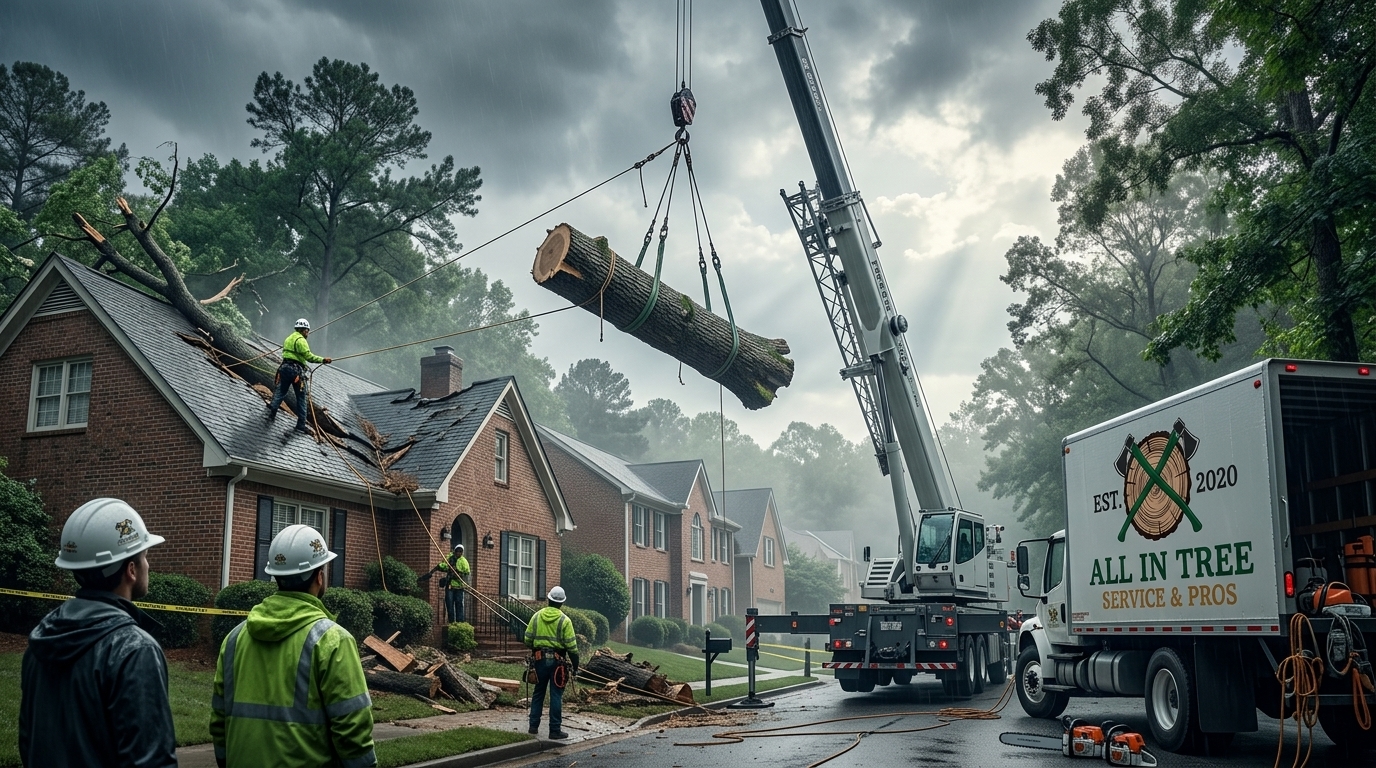
A tree that fell in an open yard is easier and cheaper to remove than one that landed on a structure, across a power line, or between two buildings. Every obstacle adds time and complexity. When a tree is on your roof, the crew has to remove it without causing further structural damage. That means rigging each section and lowering it carefully instead of letting pieces fall. I spend more time in a harness on emergency jobs than on any other type of work we do.
Time of Day
A call at 10 AM on a Tuesday costs less than the same call at midnight on a Saturday. Daytime emergency work avoids the after-hours labor premium, which typically adds 25% to 50% to the total. If your situation can safely wait until morning, it will cost less. If it cannot wait — a tree on your bedroom, a gas line at risk, a power line down — the cost of waiting is far higher than the after-hours premium.
Proximity to Power Lines
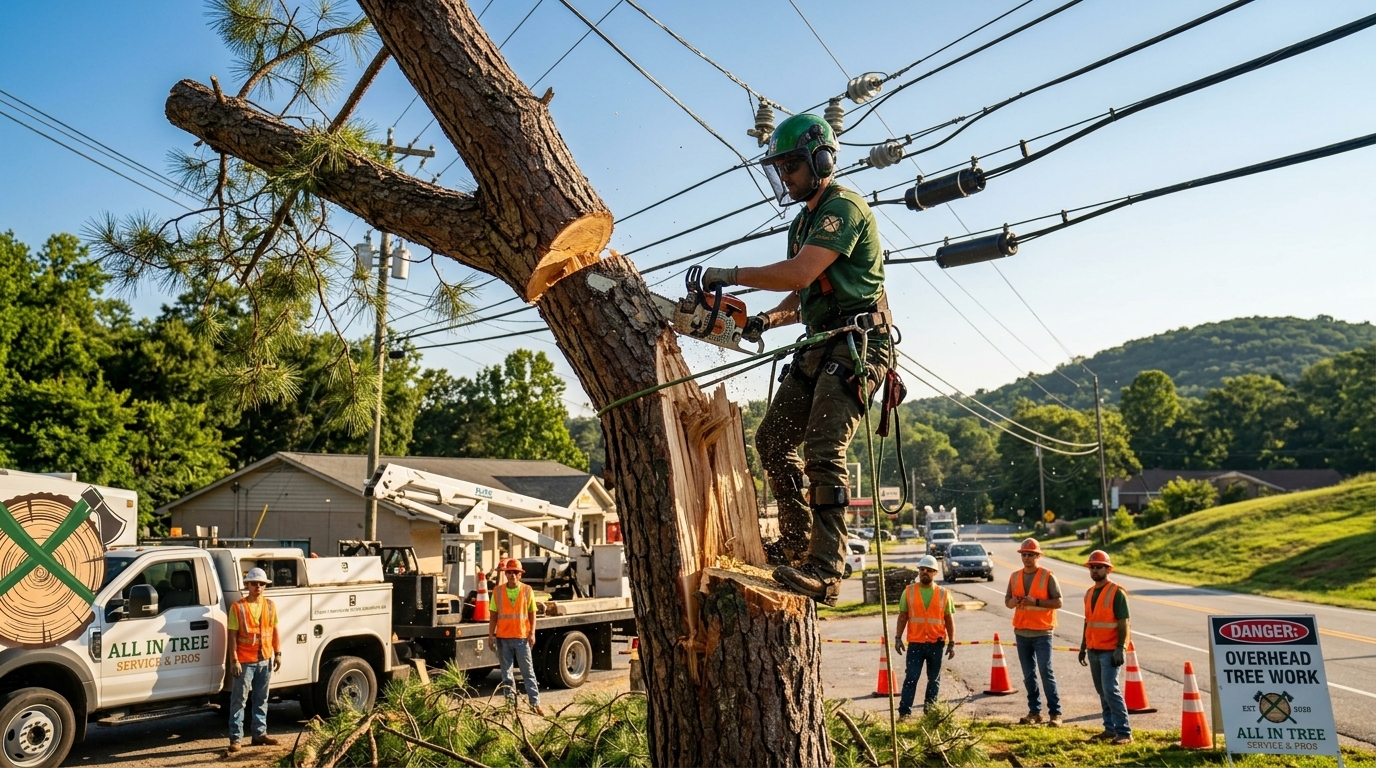
Any tree touching or near a power line requires coordination with the utility company. Georgia Power needs to de-energize the line before we can work. That coordination takes time, and the work itself requires extra safety protocols. Expect $500 to $2,000 above what the same job would cost without power line involvement.
Crane Requirements
Some emergency removals require a crane, especially when a large tree has landed on a house and cannot be safely removed with standard rigging. Crane-assisted removal adds $500 to $3,000 or more to the total, depending on the crane size and whether it is available on short notice. Rush crane mobilization costs more than a crane booked a week in advance.
Emergency vs. Planned Tree Removal: Cost Comparison
This table puts the cost difference in perspective. The same tree, removed under emergency conditions, costs significantly more than if it had been scheduled as a planned removal.
Tree Size | Planned Removal Cost | Emergency Removal Cost | Emergency Premium |
|---|---|---|---|
Small (under 30 ft) | $200 to $800 | $500 to $1,500 | +50% to 100% |
Medium (30 to 60 ft) | $800 to $1,800 | $1,200 to $3,500 | +50% to 90% |
Large (60 to 80 ft) | $1,500 to $3,500 | $2,500 to $6,000 | +60% to 75% |
Very large (80+ ft) | $3,000 to $5,000+ | $4,000 to $8,000+ | +30% to 60% |
Planned removal pricing comes from our full cost of tree removal guide. The emergency premium varies, but 25% to 100% above planned removal pricing is the realistic range depending on urgency, time of day, and job conditions.
The lesson here is straightforward: removing a tree before it becomes an emergency saves money. A dead pine that costs $1,800 as a scheduled removal could cost $3,500 or more if it falls on your garage during a storm at night.
Want to get ahead of an emergency? Call (470) 608-2545 for a free estimate on any tree you are concerned about. We would rather help you prevent the emergency than respond to one.
A Recent Emergency Call
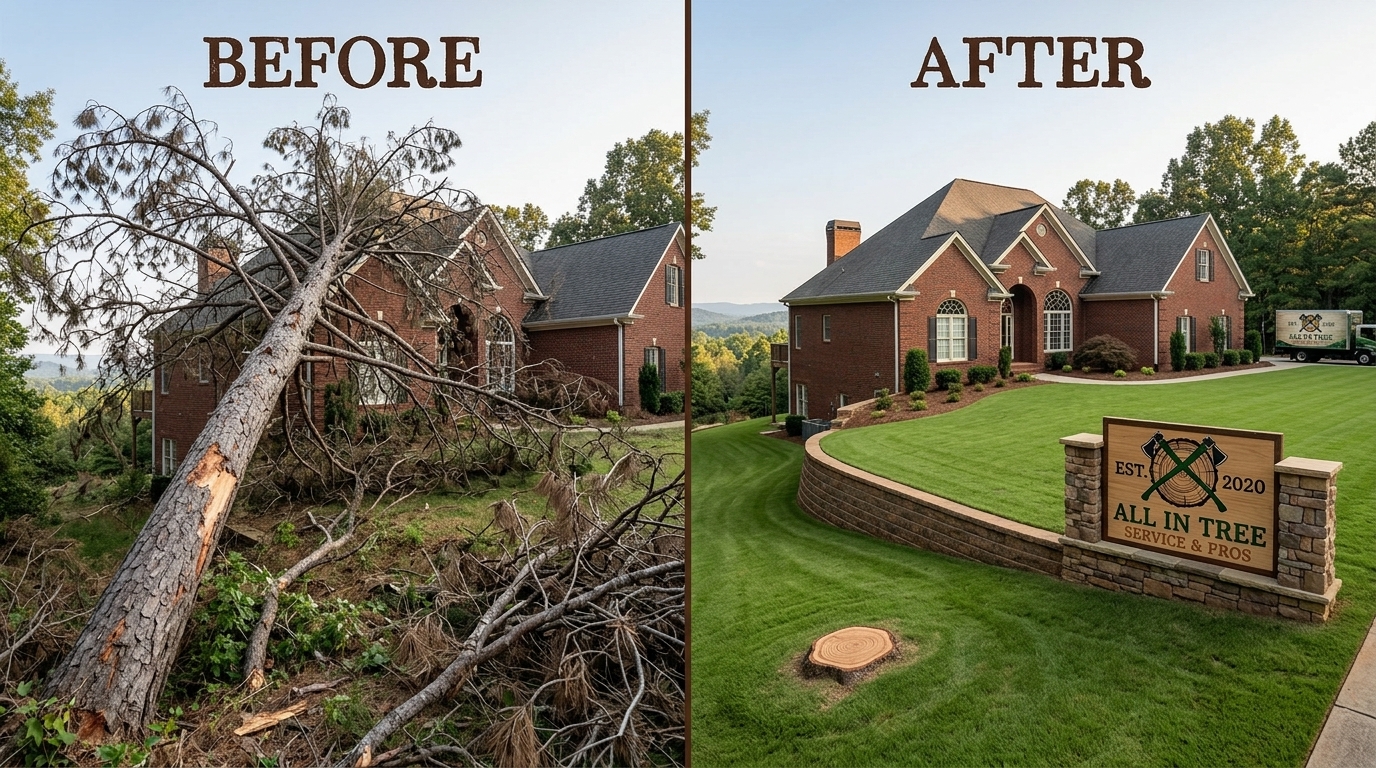
Last month, a homeowner in Smyrna called us at 6 AM after a line of severe thunderstorms moved through overnight. A 70-foot loblolly pine had snapped about 15 feet up the trunk and the top section was resting on the back half of the roof. The tree was still attached at the break point, suspended at an angle, with the crown pushing into the shingles and fascia.
We had a crew on site within two hours. The first thing we did was assess the structure from the ground — the ceiling inside was sagging in the back bedroom, so we told the homeowner to keep everyone out of that room. Our climber rigged the suspended section in three picks, cutting from the top down and lowering each piece away from the roof. The base section, still standing, came down in two more cuts.
Total time on site: five hours. The homeowner’s insurance covered the removal because the tree hit a covered structure. We documented everything with photos and provided a written breakdown of the work for the adjuster.
That job cost $3,800. A planned removal of the same tree — standing, healthy, no structural contact — would have run about $1,800 to $2,200. The homeowner told me the tree had been dead for over a year and they kept putting it off. I hear that more than anything else on emergency calls.
Does Insurance Cover Emergency Tree Removal?
This is one of the most common questions we get during emergency calls. The short answer: usually yes, if the tree hit a covered structure.
Here is how it typically works for Georgia homeowners:
Insurance usually covers removal when:
- A tree falls on your house, garage, shed, or fence
- A tree falls and blocks your driveway (some policies include this)
- Storm damage caused the tree to fall on a covered structure
Insurance usually does NOT cover removal when:
- A tree falls in the yard and misses every structure
- You want to remove a standing tree that has not fallen yet, even if it looks dangerous
- The insurer determines you knew the tree was dead or hazardous and did not have it removed
Typical coverage limits in Georgia:
- $500 to $1,000 per tree for removal after it hits a covered structure
- Total removal cap of $2,500 to $5,000 per storm event on many policies
- Your deductible applies and can eat into the coverage quickly
What to do during an emergency claim:
- Document everything before anyone touches the tree — photos of the tree, the damage, the root ball, and the surrounding area
- Call your insurance company as soon as possible
- Get a written estimate from your tree service
- Do not wait for an adjuster if the tree poses an immediate safety threat — have it removed and keep every receipt
- Ask your tree service for a detailed invoice with photos (we provide this on every emergency job)
For a deeper breakdown of how homeowners insurance works with tree removal, read our full guide on homeowners insurance and tree removal in Georgia.
How to Reduce Emergency Tree Removal Costs
You cannot always prevent a tree emergency, but you can take steps that reduce how often it happens and how much it costs when it does.
Remove Dead and Dying Trees on Your Schedule
A dead tree standing in your yard will fall eventually. The question is whether it falls on a calm Tuesday when you can schedule a crew, or during a storm at 3 AM onto your roof. Planned removal of a dead 60-foot pine costs $1,500 to $2,500. Emergency removal of that same tree after it falls on a structure costs $3,000 to $6,000. The math is clear.
Keep Up With Preventive Trimming
Regular tree trimming removes dead branches, reduces canopy weight, and makes trees more resistant to high winds. Trees trimmed every 3 to 5 years are significantly less likely to lose large branches during storms. A $400 to $800 trimming job today can prevent a $3,000 emergency call next storm season.
Inspect Your Trees After Every Storm
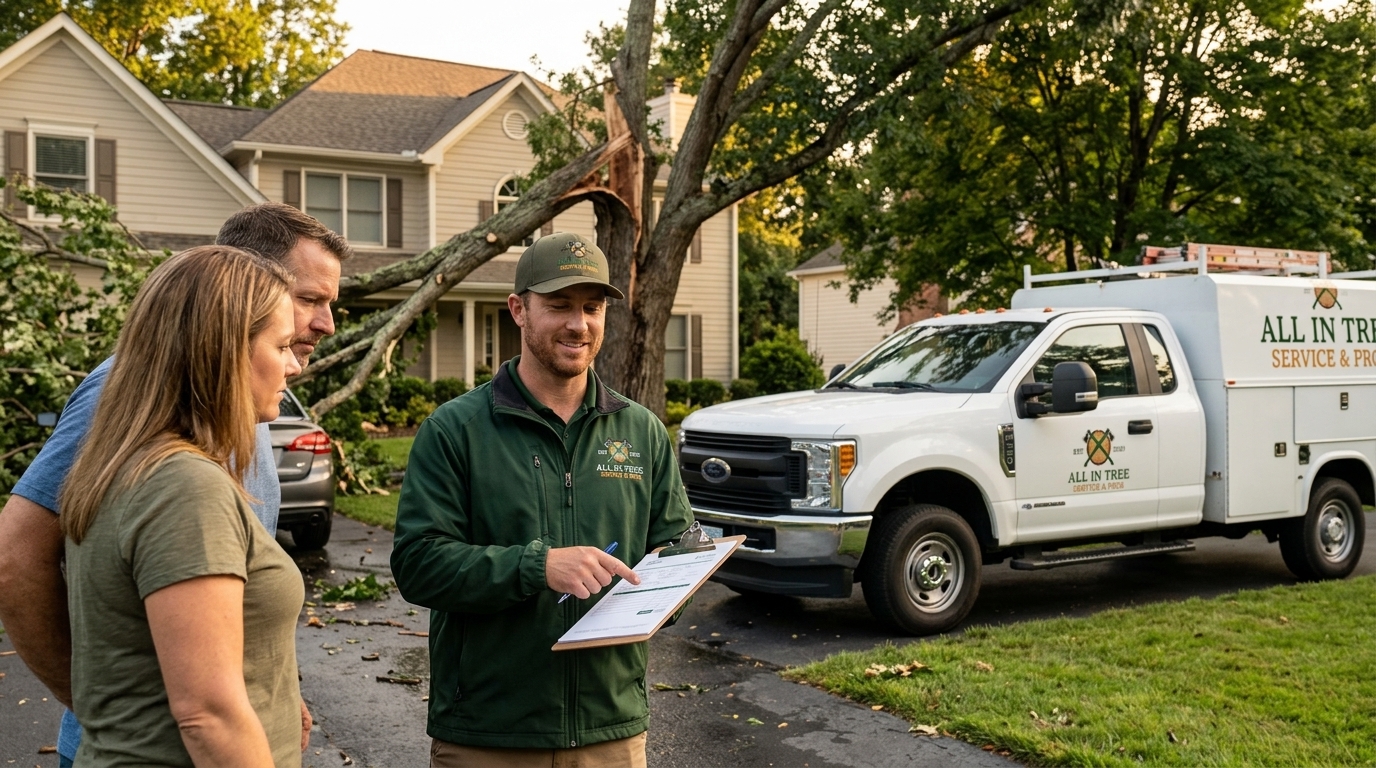
Walk your property after every significant storm and look up. Cracked branches, split crotches, and partially uprooted root balls might not fall immediately, but they will fall. Catching a cracked limb before it drops onto your house turns a potential emergency into a scheduled removal at standard pricing.
Have a Tree Service You Trust Before You Need One
The worst time to start looking for a tree service is during an emergency. You end up calling whoever answers the phone, with no way to verify their insurance, experience, or pricing. Build a relationship with a licensed, insured tree service before you need one. When the emergency hits, you already have a number to call and a company you trust.
Get Multiple Estimates for Non-Urgent Emergencies
Some emergencies are immediate: a tree on your house, a tree on a power line, a trunk that could fall at any moment. Those cannot wait. But other situations that feel urgent are actually safe to wait on for a day or two — a tree across a driveway when you have a second exit, a large limb on the ground that is not near any structure. If you can safely wait, get two or three estimates. Prices vary between companies, and a day of patience can save $500 or more.
What to Expect When You Call All In Tree Services and Pro for an Emergency
Here is the process from your first call to the completed cleanup.
Step 1: Phone Assessment
You call (470) 608-2545 and tell us what happened. We ask a few quick questions: Is anyone hurt? Is the tree touching the house, power lines, or any structure? Is anyone trapped? Can you send a photo? Based on your answers, we determine how quickly we need to get there and what equipment to bring.
Step 2: Crew Dispatch
We dispatch a crew with the right equipment for the situation. From our Powder Springs headquarters, we can reach most of Metro Atlanta within 30 to 60 minutes under normal conditions. During major storm events when crews are already deployed, we give you an honest timeframe rather than a promise we cannot keep. We prioritize trees on structures and near power lines first. Trees on the ground that are not an immediate safety threat may wait until active emergencies are cleared.
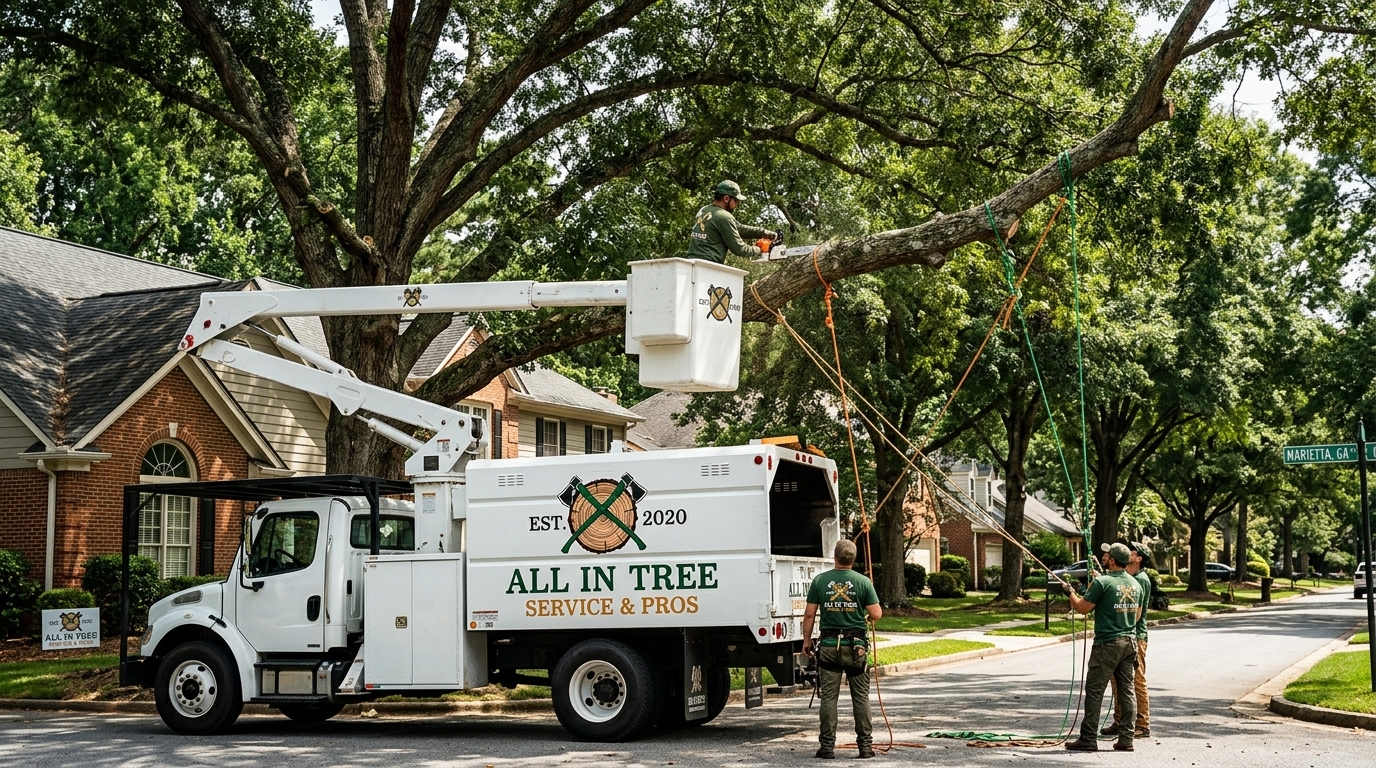
Step 3: On-Site Assessment
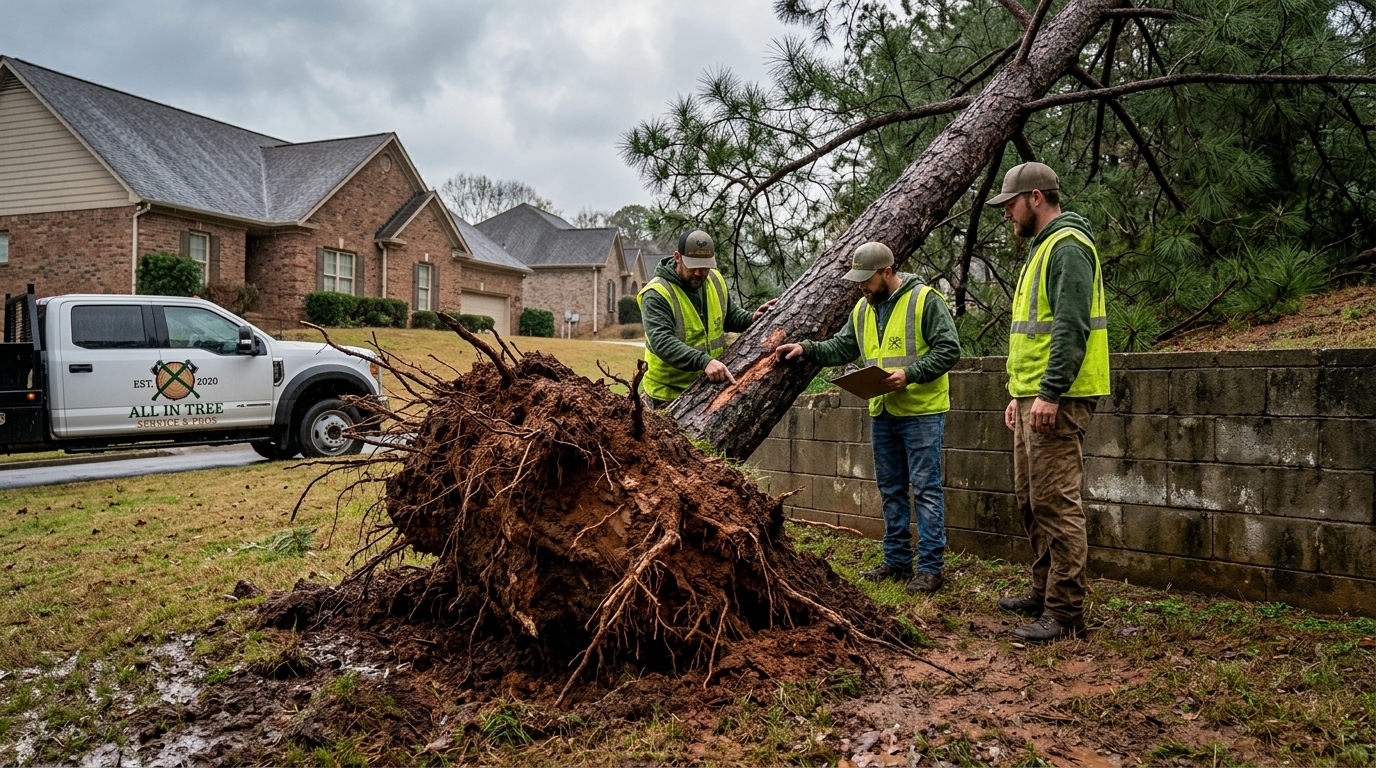
Our crew assesses the tree, the damage, and the surrounding area. We check for power lines, gas lines, structural compromise, and anything that could make the job dangerous. You get a price before we start cutting. No surprises.
Step 4: Removal
We take the tree apart in a controlled sequence, starting with the sections closest to people and structures. If the tree is on a roof, we rig and lower each piece to avoid causing further damage. If the tree is in an open area, we work faster. Either way, every cut is planned and deliberate.
Step 5: Documentation and Cleanup
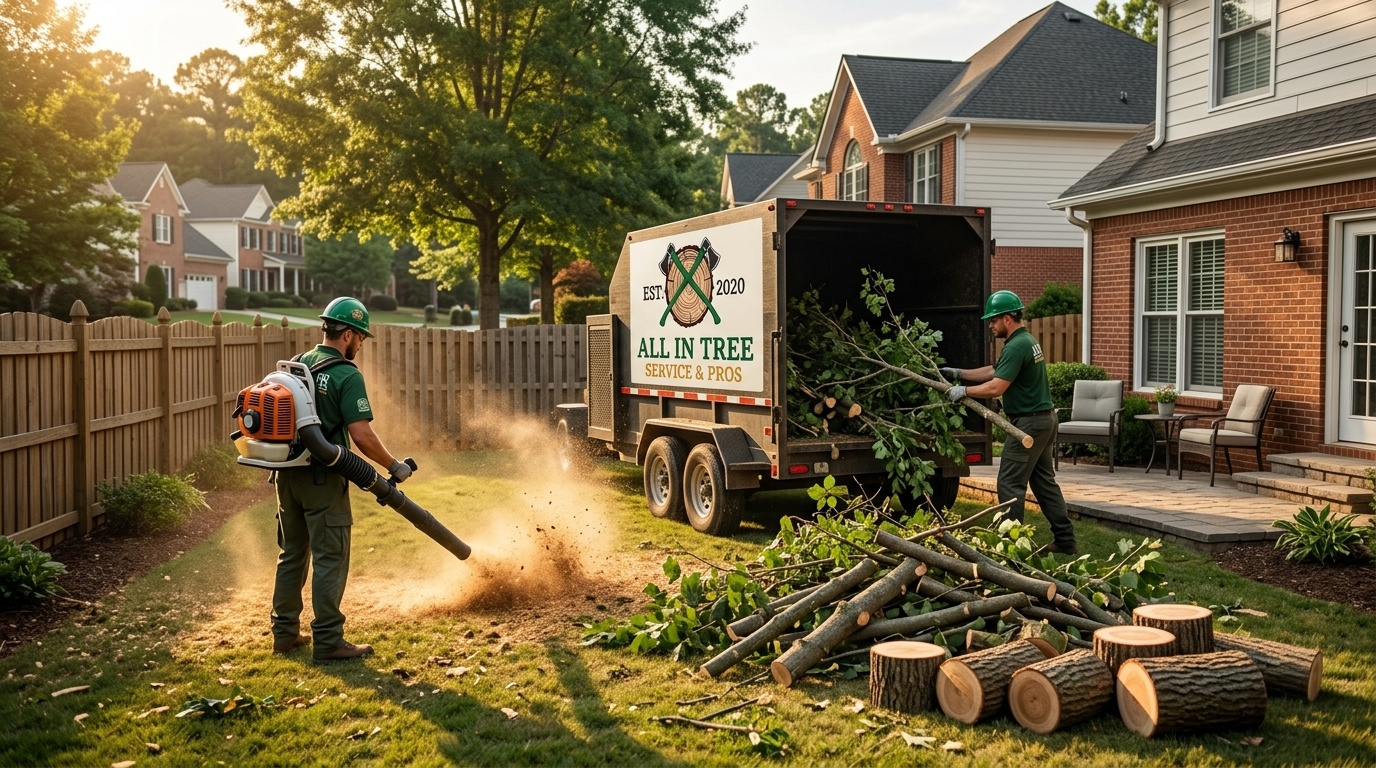
We photograph the work in progress and the completed job for your insurance records. We remove all wood, branches, and debris from your property. The stump stays unless you add stump grinding. We provide a written invoice with a breakdown of the work, which your insurance company will need.
We handle emergency tree removal 24/7, 365 days a year. Call (470) 608-2545 any time.