
I’m Rudy Perez, owner of All In Tree Services and Pro. Over 15 years of tree work across Metro Atlanta, I have watched pine beetles destroy thousands of pines on residential properties. This guide covers the pine beetle species that actually threaten Georgia trees, how to spot an infestation early, and what your options are once beetles move in.
What Are Pine Beetles?
Pine beetles are small bark beetles that bore into pine trees, feed on the inner bark, and introduce a blue stain fungus that cuts off the tree’s water and nutrient flow. The tree dies from the inside out, often within weeks.
Georgia deals with a specific set of pine beetle species. The one that causes the most destruction here is the southern pine beetle (Dendroctonus frontalis). This is the species I see doing real damage in yards across Hiram, Villa Rica, Dallas, and other west Metro Atlanta communities with heavy pine coverage.
A lot of the information online focuses on the mountain pine beetle, which is a different species that lives in the western United States and Canada. Mountain pine beetles attack lodgepole pines, ponderosa pines, and other high-elevation species. They are not a factor here in Georgia. If you live in Metro Atlanta and your pines are dying, the mountain pine beetle is not your problem.
Pine Beetle Species That Affect Georgia
Three species do the most damage to Georgia pines. Each one behaves differently, but they all kill trees.
Southern Pine Beetle (Dendroctonus frontalis)
This is the primary threat. Southern pine beetles are tiny, roughly the size of a grain of rice, and they attack in massive numbers. A single tree can host thousands of beetles. They bore through the outer bark and carve S-shaped tunnels (called galleries) through the inner bark and cambium layer. That is the tissue the tree depends on for moving water and nutrients.
Southern pine beetles also carry a blue stain fungus (Ophiostoma) that they introduce into the sapwood. The fungus clogs the tree’s vascular system. Between the physical damage from the tunnels and the fungal blockage, the tree loses its ability to transport water. It dies fast, sometimes in two to four weeks during peak summer heat.
These beetles prefer loblolly pines, shortleaf pines, and Virginia pines. All three grow heavily across Metro Atlanta properties.
Ips Engraver Beetles
Ips beetles are the second most common bark beetles I see in Georgia yards. They typically attack trees that are already weakened by drought, storm damage, or construction activity. Ips beetles tend to hit individual trees or small groups rather than sweeping through entire stands the way southern pine beetles do.
You can tell Ips damage apart from southern pine beetle damage by the gallery patterns. Ips beetles carve Y-shaped or H-shaped tunnels, while southern pine beetles carve the distinctive S-shaped pattern. Ips beetles also tend to start in the upper crown and work downward, while southern pine beetles usually attack the mid-trunk first.
Black Turpentine Beetle
Black turpentine beetles are the largest of the three, about the size of a small pencil eraser. They attack the lower trunk of the tree, usually within the first six to eight feet from the ground. You will see large, quarter-sized pitch tubes near the base of the tree.
These beetles often move in after construction activity, root damage, or soil compaction around the root zone. I see them frequently on properties where a driveway was widened, a new patio was installed, or heavy equipment drove over the root area during a home renovation.
Black turpentine beetles kill trees more slowly than southern pine beetles. A tree with a mild black turpentine beetle attack can sometimes survive if it is otherwise healthy and the infestation is caught early. But once the population builds or other beetle species join in, the tree is finished.
How Pine Beetles Kill a Tree
Here is what happens inside a pine tree once beetles arrive.
- Scout beetles find a weak tree. The first few beetles (called “pioneer” beetles) locate a stressed tree by detecting chemical signals the tree releases. A pine under drought stress, root damage, or overcrowding puts out different volatile compounds than a healthy tree. The beetles pick up on these signals.
- Mass attack. Pioneer beetles release aggregation pheromones that attract hundreds or thousands of additional beetles. The swarm bores through the bark within hours.
- Gallery construction. Beetles tunnel through the inner bark and cambium, carving out egg galleries. Female beetles lay eggs along these tunnels.
- Fungal infection. Beetles introduce blue stain fungus into the sapwood. The fungus spreads through the tree’s vascular system, blocking water movement.
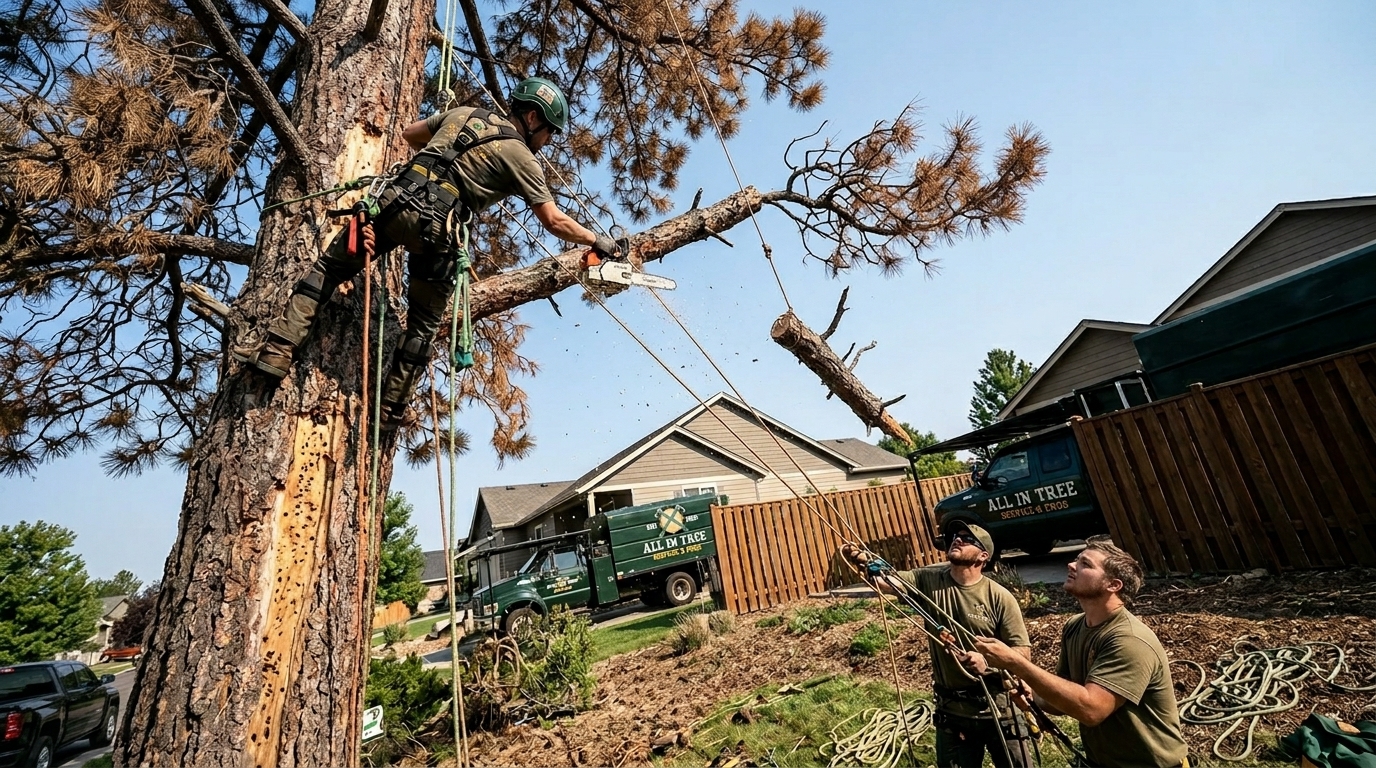
- Tree death. The combination of severed cambium, clogged sapwood, and larvae feeding on inner bark kills the tree. The needles fade from green to yellow to red-brown.
- New generation emerges. Larvae develop into adults, bore out of the dead tree, and fly to neighboring pines. The cycle repeats, and the infestation spreads outward.
This entire process can happen in as little as 30 days during hot Georgia summers.
Signs of Pine Beetle Infestation
Catching an infestation early gives you the best chance to protect the surrounding trees. Here is what to look for.
Pitch Tubes
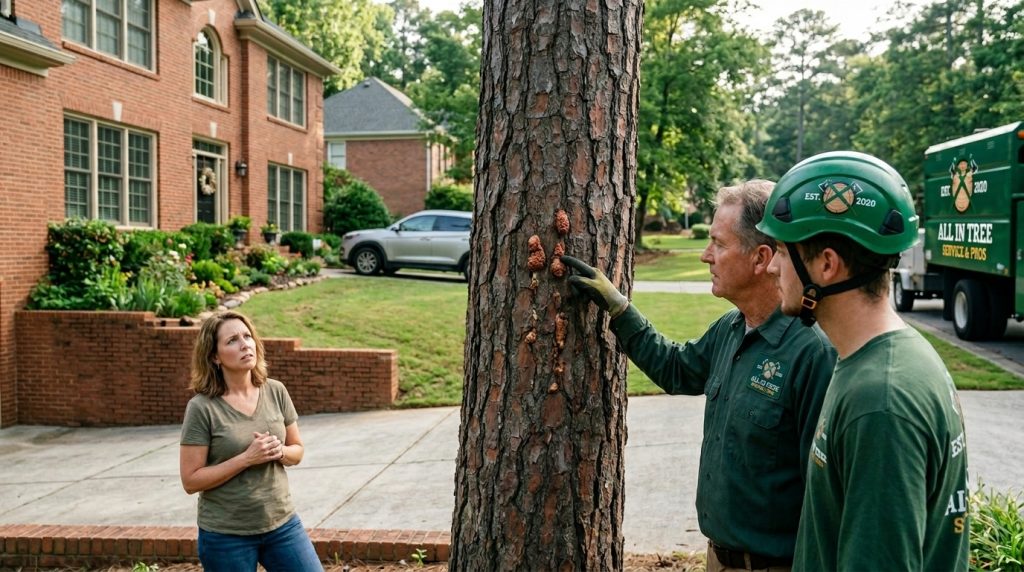
Pitch tubes are small masses of resin (sap) that form on the bark where beetles have bored in. On a healthy tree with strong resin flow, these look like popcorn-sized blobs of sticky, white or amber sap on the trunk. On a severely stressed tree, the pitch tubes may be very small or reddish-brown because the tree does not have enough resin pressure to push the beetles back out.
Check the trunk from ground level up to about 30 feet. Southern pine beetle pitch tubes typically appear on the mid-trunk. Black turpentine beetle pitch tubes cluster near the base.
Boring Dust (Frass)
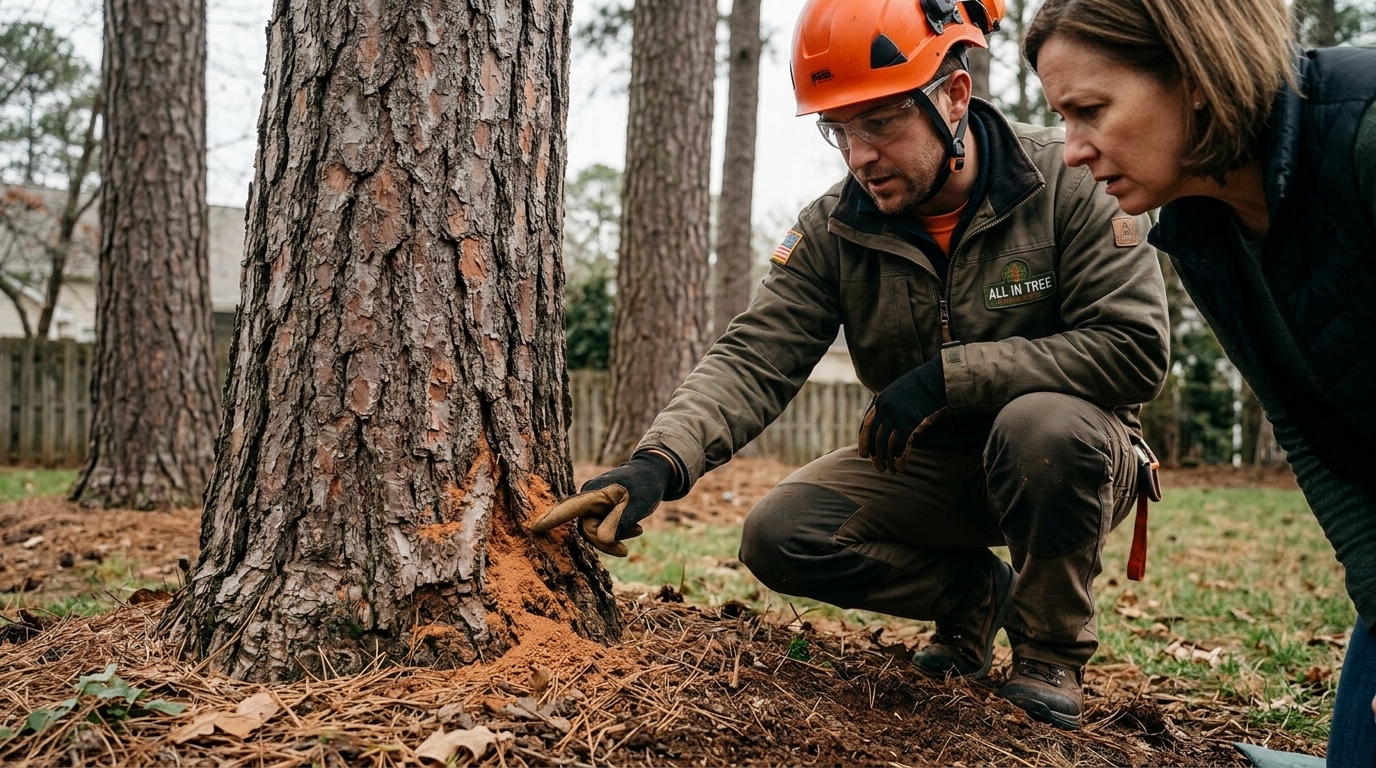
Fine, reddish-brown sawdust collects in bark crevices and at the base of the tree. This boring dust, called frass, is a mix of chewed bark and beetle waste. If you see frass piling up around the trunk base or caught in spider webs on the bark, beetles are actively boring.
Needle Discoloration and Crown Fade
This is the most visible sign, but by the time you see it, the damage is already done.
- Green crown: The beetles may already be inside, but the tree has not shown symptoms yet. Check for pitch tubes and frass.
- Yellow/green fade: The needles are starting to lose color. The tree’s water supply is compromised. At this stage, the tree almost certainly cannot be saved.
- Red/brown crown: The tree is dead. The needles turn reddish-brown and eventually drop. Beetles have likely already emerged and moved to neighboring trees.
Bark Flaking and Woodpecker Activity
Woodpeckers feed on bark beetle larvae. If you see heavy woodpecker activity on a pine, with bark being chipped away in patches, that tree likely has a beetle infestation. The woodpeckers are digging for larvae under the bark.
You may also notice bark falling off in sheets, exposing the tunnel galleries underneath. The S-shaped tunnels of the southern pine beetle are distinctive and unmistakable.
Summary of Pine Beetle Infestation Signs
- Popcorn-like pitch tubes on the trunk (white, amber, or reddish-brown)
- Reddish-brown boring dust in bark crevices and at the tree base
- Fading needles: green to yellow-green to red-brown
- Woodpecker damage with bark stripped in patches
- Bark peeling to reveal winding tunnels underneath
- Groups of pines dying together in a circular or expanding pattern
Pine Beetle Season in Georgia
Southern pine beetles are active year-round in Georgia’s mild climate, but populations explode during the warmer months. Here is the general timeline.
Spring (March to May): Overwintering beetles become active as temperatures rise. The first generation of the year begins attacking new trees. This is a critical monitoring window.
Summer (June to August): Peak activity. Hot, dry conditions stress pines and reduce their ability to produce defensive resin. Beetle reproduction accelerates, with a new generation completing its lifecycle every 30 to 60 days. Multiple generations can overlap in a single summer.
Fall (September to November): Activity slows but does not stop. Warm fall weather in Georgia can extend the active season well into November.
Winter (December to February): Activity drops significantly but does not cease entirely. Georgia winters rarely get cold enough for a hard freeze that would kill beetle populations.
Drought years are the worst. I have seen entire rows of pines along property lines in Lithia Springs and Fayetteville go from healthy green to completely red in a single summer during drought conditions.
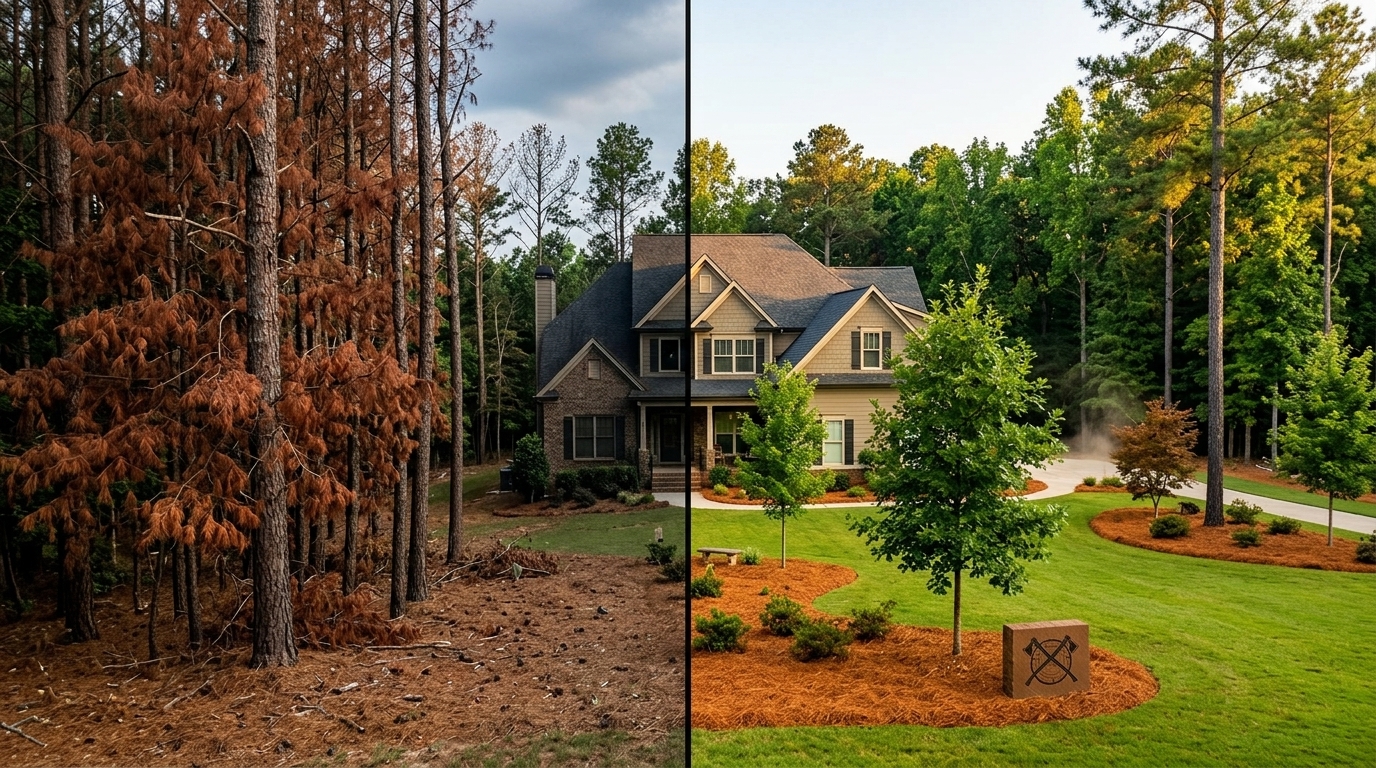
What to Do If You Find Pine Beetle Signs
If you spot pitch tubes, boring dust, or fading needles on one of your pines, here is the step-by-step process I recommend.
Step 1: Evaluate the Infested Tree
Look at the crown color. If the needles are still fully green and you are only seeing pitch tubes, there is a small window to act. If the needles have started fading to yellow or red, the tree is too far gone. Chemical treatment will not save a tree that has already lost its water supply to beetle tunnels and fungal blockage.
Step 2: Check the Surrounding Trees
Pine beetles spread outward from the initial attack tree. Walk your property and inspect every pine within 100 feet. Look for fresh pitch tubes and boring dust on neighboring trunks. If you see signs on multiple trees, the infestation is already spreading.
Step 3: Call a Professional
This is not a DIY situation. Pine beetle infestations spread fast, and the window to protect your remaining trees is short. Our team can evaluate the full scope of the problem, identify which trees are still saveable, and recommend the right course of action. Call us at (470) 608-2545 for an evaluation.
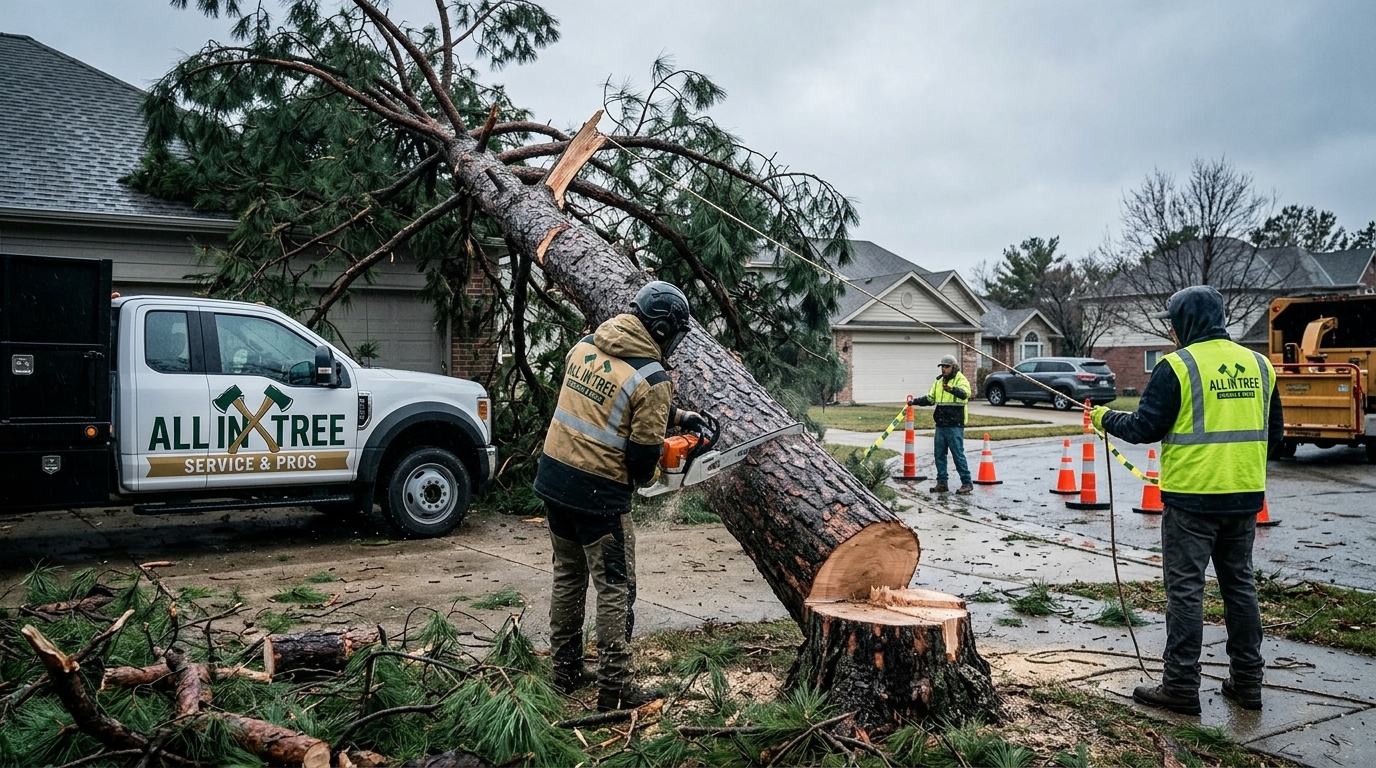
Step 4: Remove Infested Trees Promptly
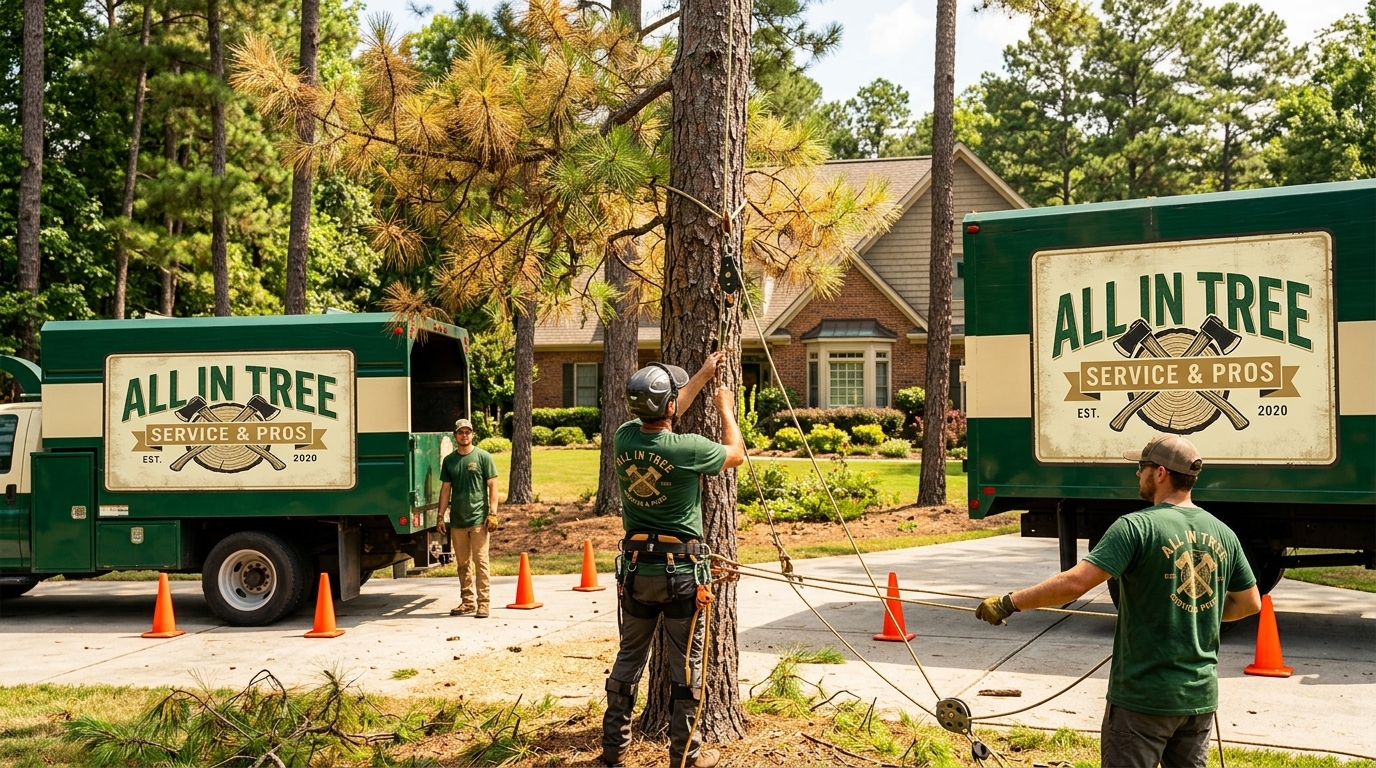
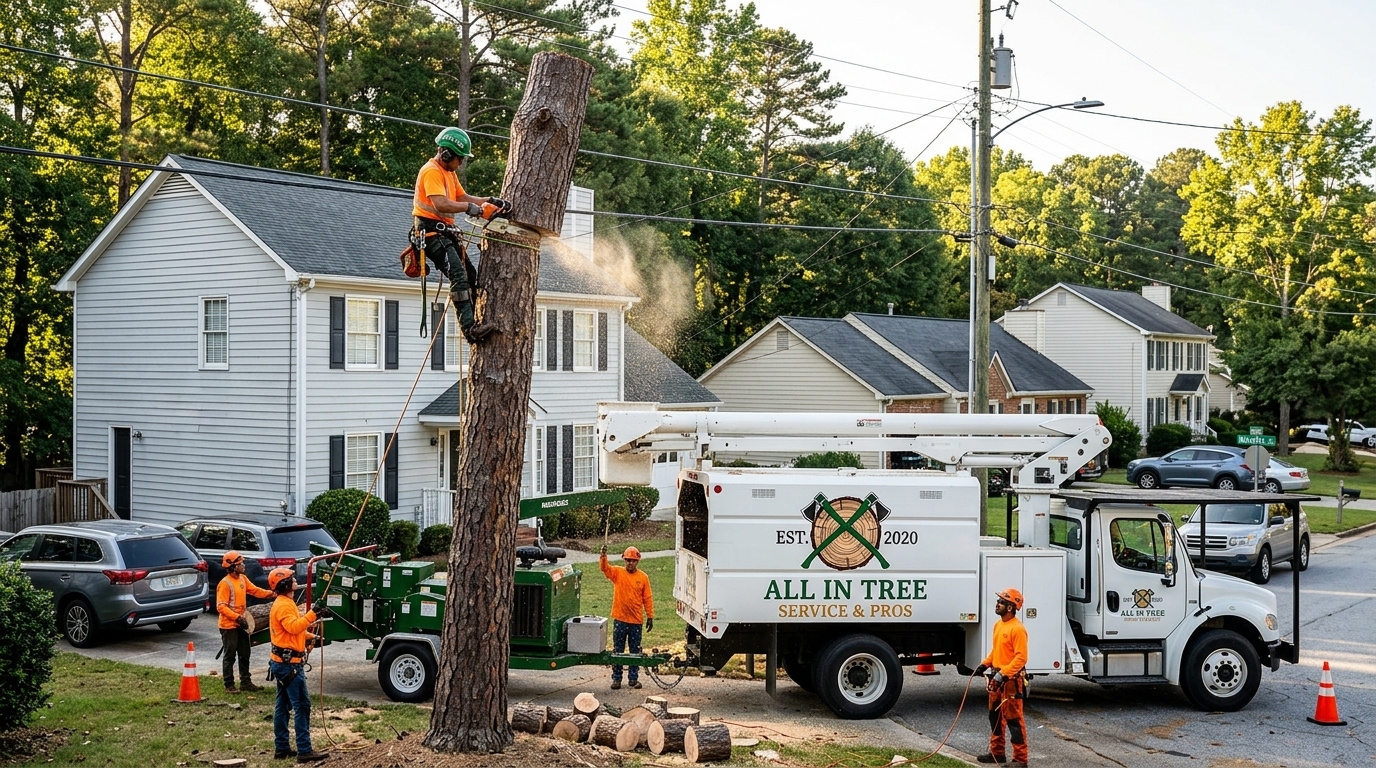
The single most effective action against an active pine beetle infestation is removing the infested trees quickly. Every day an infested tree stands, it produces more beetles that fly to your other pines. Prompt tree removal breaks the cycle.
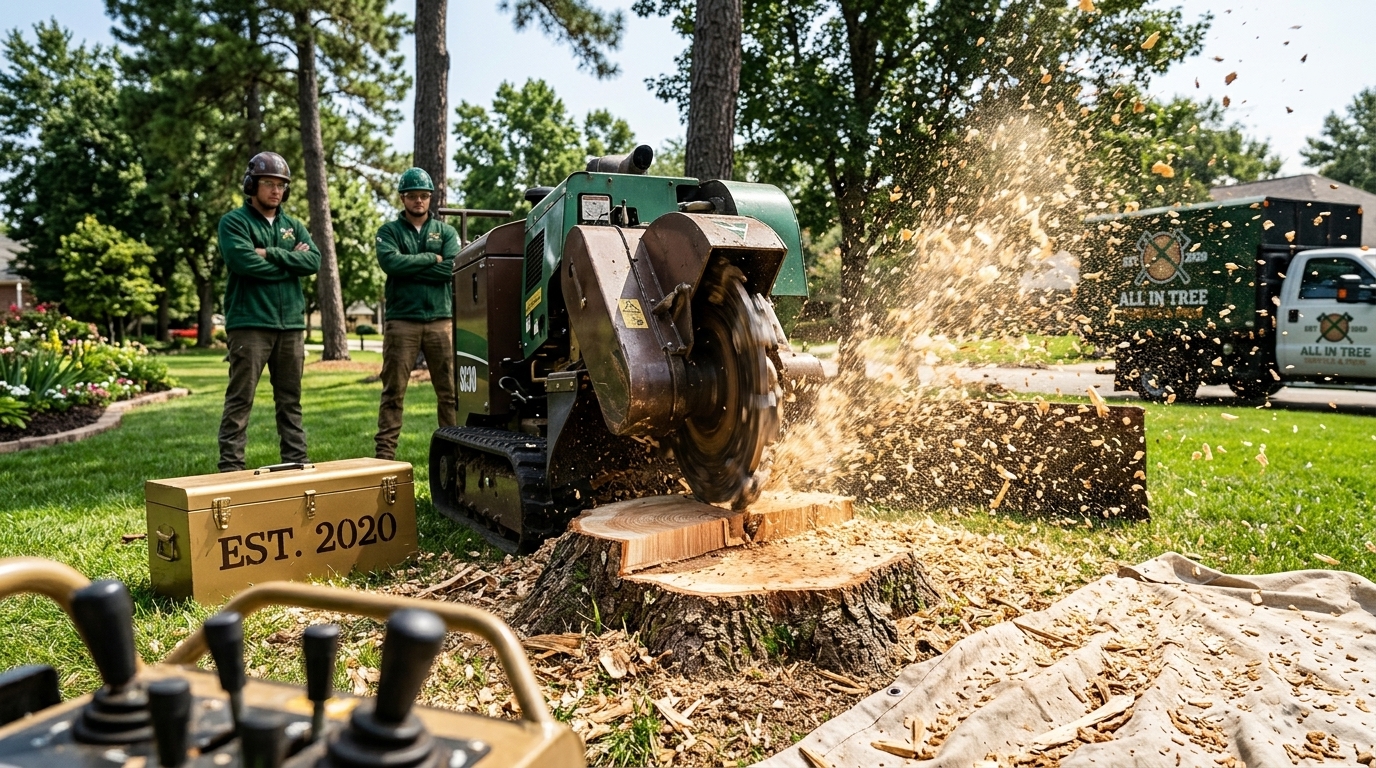
After removal, stump grinding eliminates the remaining stump and any larvae still developing in the lower trunk and root flare.
Can the Tree Be Saved?
This is the question I get asked most, and I always give an honest answer.
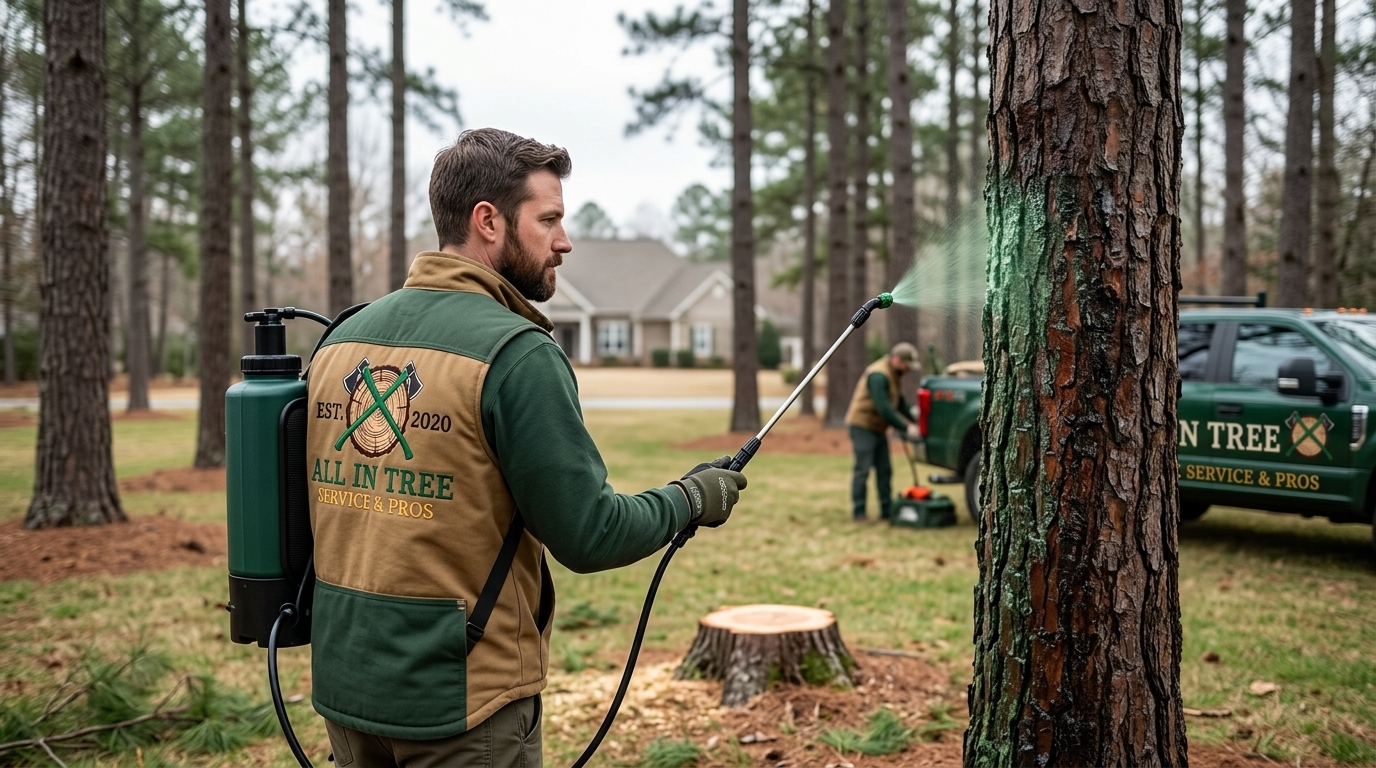
If the crown is still green and the infestation is light: There is a chance. A certified arborist can apply preventive insecticide treatments (usually containing bifenthrin or carbaryl) to the bark of uninfested trees near the outbreak. This creates a chemical barrier that kills beetles on contact before they can bore in. Preventive treatments work well on healthy trees that have not yet been attacked.
If the crown is fading or the tree has heavy pitch tube activity: The tree cannot be saved. Once beetles have established galleries under the bark and the blue stain fungus has spread through the sapwood, no chemical treatment can reverse the damage. Injecting or spraying an already-infested tree wastes money and wastes time you should be using to protect the remaining healthy trees.
Here is the honest truth: Most homeowners do not notice a pine beetle problem until the needles start changing color. By that point, the tree is already dead. The priority shifts from saving that tree to protecting everything around it.